
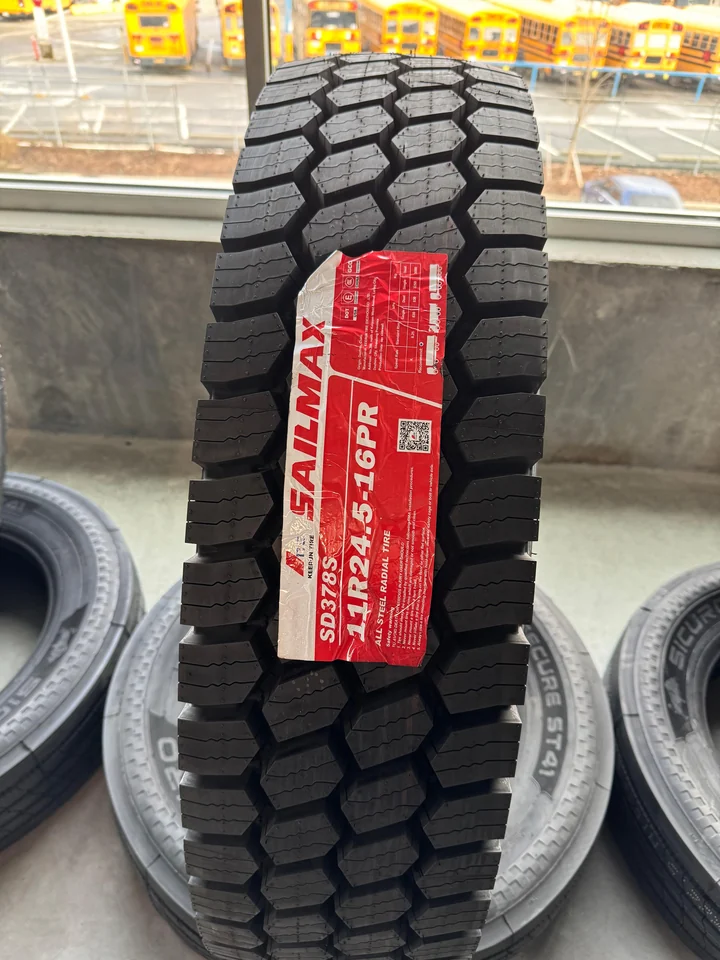
Steer tires prioritize directional control and even wear, drive tires use traction-focused tread designs to transmit engine torque, and trailer tires are built for free-rolling axles and scrub resistance. Many steer tires are marked for all-position use, but every product must be approved by its manufacturer for the intended axle, load and application.
01 · COMMERCIAL TIRE SELECTION
Steer and all-position tires
Steer tires run on the front axle and directly affect steering response, water evacuation and vehicle stability. Their tread commonly uses continuous ribs and circumferential grooves to support tracking and even wear.
Some manufacturers label these products all-position tires. Michelin, for example, uses Z for steer or all-position. That marking can permit other axle applications, but it does not mean every rib tire suits every job. Regional, long-haul, urban and on/off-road service place different demands on a casing and tread compound.
02 · COMMERCIAL TIRE SELECTION
Drive tires and block tread
Drive tires are designed for powered axles. Their larger blocks, transverse grooves and biting edges help transfer torque and provide traction during acceleration, climbing and loose or winter conditions. Michelin uses D to identify drive-position designs.
A more aggressive pattern can trade some rolling efficiency or wear characteristics for traction. Match the design to the route: highway line-haul, regional delivery, construction access and severe winter work do not need the same tread.
03 · COMMERCIAL TIRE SELECTION
Trailer tires and free-rolling service
Trailer tires do not steer the tractor or transmit engine power. They are selected for free-rolling service, load support, durability, low rolling resistance and resistance to lateral scrub during tight turns. Michelin uses T for trailer-position products.
A straight or shallow rib pattern is common, but appearance is not an approval. Confirm the manufacturer's position designation, service description and application before mounting a tire on a trailer axle.
04 · COMMERCIAL TIRE SELECTION
Why size and appearance are not enough
Two tires can both be 11R22.5 and look similar while having different load ranges, speed capabilities, compounds, casing designs and approved applications. USTMA guidance says each truck axle should use the same size, similar tread design and construction. Paired dual tires also need proper matching.
Before ordering, identify the complete size, load range or service description, axle position, operating weight, route, speed and season. For duals, check overall diameter or circumference compatibility rather than pairing tires only because their sidewalls show the same nominal size.
05 · COMMERCIAL TIRE SELECTION
Where wide-base tires fit
Wide-base sizes such as 425/65R22.5 form a separate fitment decision. Depending on the exact product, they may serve steer, drive, trailer or vocational applications and require an approved wheel width, adequate clearance and correct load-and-inflation specification.
Never classify a wide tire as a drive tire solely because it has large tread blocks. Use the product data sheet and vehicle requirements to confirm axle approval and fitment.
KEEP THIS HANDY
Quick checklist
- Identify steer, drive, trailer or lift-axle position
- Read the complete tire designation and service description
- Confirm the manufacturer's axle-position approval
- Match route and operating conditions
- Use compatible tires across an axle
- Properly match dual tires
- Verify wheel, clearance, load and inflation requirements
Sources and further reading
Specifications and regulations can change. Follow the current vehicle, tire-manufacturer and government guidance for your situation.