
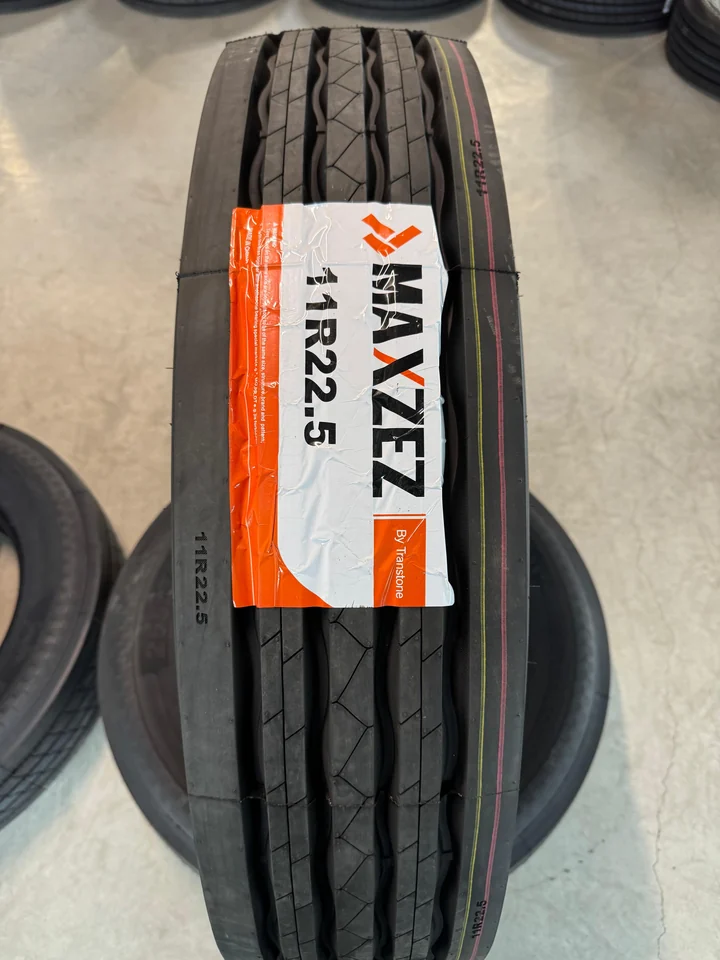
11R22.5 and 11R24.5 are different sizes built for different rim diameters. The 11R24.5 is normally taller and turns fewer revolutions per mile, but exact dimensions and load capacities vary by product. They cannot be mounted on the same wheel or substituted without checking the vehicle, wheel, clearance, gearing, dual matching and manufacturer specifications.
01 · COMMERCIAL TIRE SIZES
What the size markings mean
In both sizes, 11 is the nominal section-width designation and R means radial construction. The final number is the wheel's nominal bead-seat diameter: 22.5 inches for 11R22.5 and 24.5 inches for 11R24.5.
That 2-inch rim difference makes the two tires physically incompatible with the same wheel. An 11R24.5 tire must never be forced onto a 22.5-inch wheel, and an 11R22.5 tire does not belong on a 24.5-inch wheel.
02 · COMMERCIAL TIRE SIZES
The 11R24.5 is generally taller
Manufacturer data illustrate the difference, but the exact numbers depend on the tread model. In Bridgestone's published M770 specifications, the 11R22.5 is listed at 42.2 inches overall diameter and 492 revolutions per mile, while the 11R24.5 is 44.2 inches and 470 revolutions per mile.
Other product lines publish slightly different dimensions. Use the current specification sheet for the exact tire being purchased rather than treating one model's measurements as universal.
03 · COMMERCIAL TIRE SIZES
Why diameter changes vehicle operation
A taller tire travels farther per revolution. Changing overall diameter can affect effective gearing, engine speed at road speed, ride height, speedometer and odometer accuracy, ABS, traction-control logic and available clearance.
USTMA advises checking body, chassis, brake and suspension clearance through the full range of steering and suspension movement. Vehicle-manufacturer approval may be required, and electronic systems may need recalibration.
04 · COMMERCIAL TIRE SIZES
Load range and pressure still need confirmation
Size alone does not establish capacity. Load range, single or dual application, wheel rating and cold inflation pressure work together. Two tires of the same nominal size can have different service limits.
Determine the actual axle load and use the tire manufacturer's current load-and-inflation table. Never exceed the wheel manufacturer's load or pressure limit, even if the tire is rated higher.
05 · COMMERCIAL TIRE SIZES
Do not mix these sizes on an axle or in a dual pair
Ontario and industry guidance require compatible tire sizes and construction across an axle. Large differences in diameter make 11R22.5 and 11R24.5 unsuitable as a mixed pair, and dual tires must be closely matched so one tire does not carry a disproportionate share of the load.
When changing from one size system to another, evaluate the complete vehicle and every affected wheel position. For a routine replacement, follow the vehicle placard, fleet specification or approved equivalent rather than choosing whichever size is available.
KEEP THIS HANDY
Quick checklist
- Confirm the rim is 22.5 or 24.5 inches
- Use the exact tire model's data sheet
- Compare overall diameter and revolutions per mile
- Check wheel and vehicle load limits
- Verify full steering and suspension clearance
- Match dual tires correctly
- Obtain vehicle or fleet approval before changing size
Sources and further reading
Specifications and regulations can change. Follow the current vehicle, tire-manufacturer and government guidance for your situation.